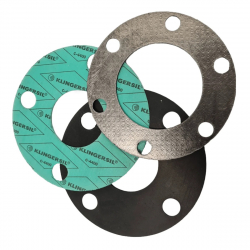
Choosing the Right Material and Profile for Your Piping System
In the world of fluid handling and process piping, a gasket is the critical component that stands between structural integrity and a catastrophic leak.
While all gaskets serve the same basic purpose, to fill the micro-imperfections between two mating flange faces and create a static seal, choosing the correct material and profile is vital for safety, efficiency, and longevity.
Depending on your operating pressures, temperatures, and chemical exposure, industrial gaskets generally fall into three distinct categories: metallic/semi-metallic (spiral wound), elastomeric (EPDM), and fibre/laminate sheets (non-asbestos and reinforced graphite).
The Three Core Material Types
- Spiral Wound Gaskets (Semi-Metallic)
Engineered for the absolute toughest environments, spiral wound gaskets are the industry standard for high-pressure and high-temperature systems.
- The Design: They are constructed by spirally winding a V-shaped metallic strip (typically 316L Stainless Steel) together with a soft filler material like flexible graphite.
- The Benefit: The V-shaped metal layers act like a heavy-duty spring, giving the gasket dynamic recovery. This allows it to automatically adjust to intense pressure surges, thermal expansion, and pipe vibrations.
- Common Builds: Configurations range from Carbon Steel Outer / Stainless Inner setups for standard refinery steam lines, to All-Stainless Steel (Inner & Outer) designs built to withstand severe external atmospheric corrosion, saltwater, and aggressive chemical washes.
- General-Purpose Non-Asbestos & Reinforced Graphite (Fibre/Laminates)
Sheet gaskets bridge the gap between rubber flexibility and metallic strength.
- Non-Asbestos Fiber: Made from synthetic aramid fibres bound with high-quality elastomers, these are the dependable, everyday choice for standard utility piping, water lines, and low-pressure steam.
- Reinforced Graphite (KLINGER® PSM-AS): For high-temperature process lines where non-asbestos fibres reach their limit, tanged graphite is the premier solution. Premium materials like KLINGER® Graphite PSM-AS feature a 0.1mm tanged stainless steel 316 core mechanically bonded to pure exfoliated graphite. This glueless design offers incredible blowout resistance, eliminates chemical degradation, and utilizes an anti-stick coating for clean removal during maintenance.
- EPDM Gaskets (Elastomeric/Rubber)
When flexibility and excellent environmental resistance are required at lower pressures, EPDM gaskets are the ideal choice.
- The Benefit: Ethylene Propylene Diene Monomer (EPDM) is highly resilient and handles UV rays, ozone, weathering, and water exceptionally well.
The Trade-Off: Because it is a soft rubber, it conforms beautifully to uneven surfaces under low bolt torque, making it highly effective for outdoor water infrastructure and cooling loops. However, it should be kept away from oils, fuels, and extreme temperatures.