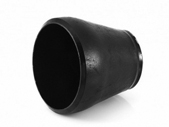
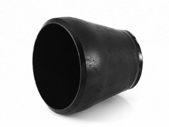
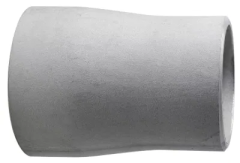
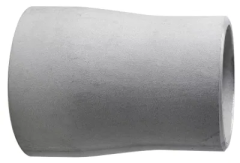
A buttweld concentric reducer is a pipe fitting that smoothly transitions the flow between two different diameter pipes that share a common centerline.
This design minimises turbulence and pressure loss, making it suitable for efficient fluid transport in high-pressure and high-temperature industrial piping systems.
Key Features and Applications
- Symmetrical Transition: Unlike an eccentric reducer, a concentric reducer is symmetrical, ensuring that the centerlines of both the larger and smaller pipes remain aligned. This design is generally preferred for vertical gas and fluid flow to avoid pooling of fluid on one side.
- Efficient Flow: By providing a gradual and even reduction in pipe size, it helps to minimise flow disturbances (turbulence) and pressure loss, contributing to efficient system operation.
- High Integrity Connection: Installed using circumferential butt welds, it creates a permanent, secure, and leak-proof connection capable of withstanding demanding operational pressures and thermal cycling.
Materials and Standards
Concentric reducers are available in various materials and adhere to strict industry standards.
- Materials: Common options include carbon steel (e.g., ASTM A234 WPB) for general industrial use, and stainless steel (e.g., ASTM A403 WP304/L, WP316/L) for corrosive environments. Other materials like alloy steel and duplex steel are used in specialized applications.
- Standards: Dimensions, wall thickness, and materials typically conform to standards such as ASME B16.9, BS1640, and MSS SP-43. Wall thickness is specified by the pipe schedule (e.g., Sch 10, Sch 40, Sch XXS).