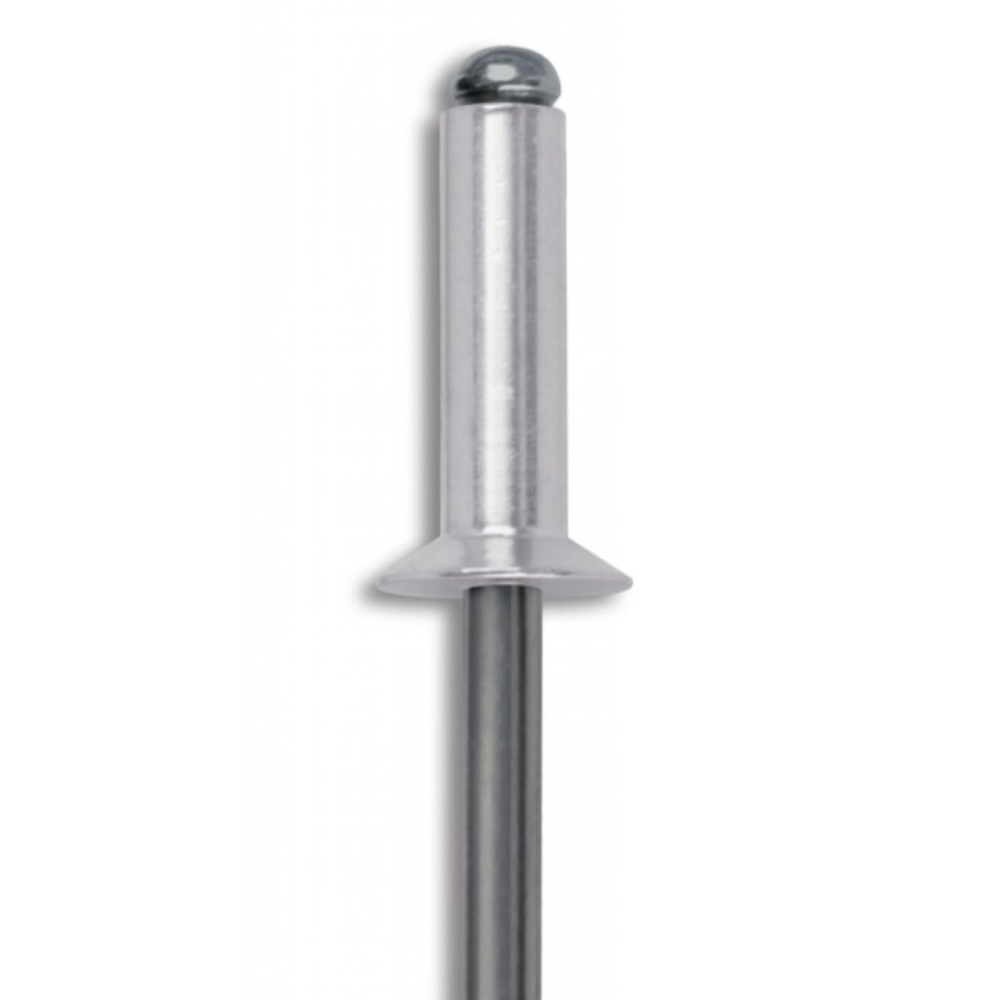
Countersunk blind rivets, also known as flush-head rivets, are specifically designed to sit flush with or slightly below the surface of the material.
They are the standard choice for applications where a protruding head would cause interference, such as in sliding tracks, or where a smooth, aerodynamic finish is required, such as on aircraft skins or automotive panels.
Key Features & Installation
Installing these rivets requires more preparation than standard dome heads because the material must be modified to accept the cone-shaped head.
120° Head Angle: Most countersunk blind rivets follow a standard 120-degree head angle. This is wider and shallower than the 82° or 90° angles typical for screws, and different from the 100° angle used for solid aviation rivets.
Hole Preparation: To achieve a perfectly flush finish, you must use a 120° countersink bit to create a conical recess in the top sheet.
Material Thickness: The top sheet must be thick enough to accommodate the countersink depth (often at least 1mm).
Lorem ipsum dolor sit amet, consectetur adipiscing elit. Mauris euismod ultrices accumsan. Nullam congue nunc ipsum, ut aliquam elit bibendum eu. Vivamus malesuada nulla nec eros scelerisque lacinia. Nullam vestibulum ornare est. Nulla eget mollis tellus, ut fringilla risus. Morbi malesuada, ante eget posuere sagittis, velit enim pretium libero, eget interdum lacus ipsum a nisi. Maecenas metus ex, finibus id sem sed, placerat posuere arcu. Curabitur non ante sit amet felis tincidunt interdum sed ut velit.